



An Interview with CAS President Barry Franklin
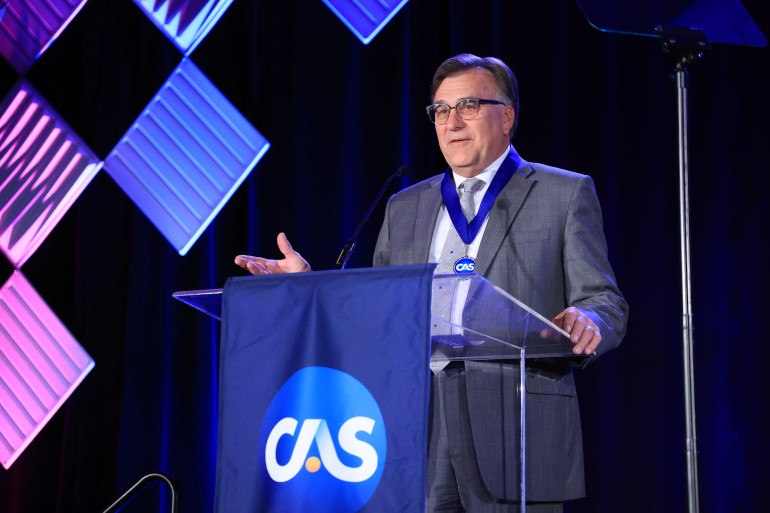
I had an opportunity to sit down with new CAS President Barry Franklin in November at the CAS Annual Meeting in Austin. As a CAS candidate myself, I wanted to ask questions geared toward what would be most helpful or interesting for others in a similar situation. I had a great conversation with Barry and learned more about what the CAS president does and how the CAS is positioned to succeed into the future.
Jason:
My goal in this interview is to share some optimism about the future state of the CAS and the candidate experience. I’d like to learn a little bit more about you and your role, some current initiatives regarding candidates, and some other topics related to the CAS Strategic Plan. Would you like to make an overall comment on what your goals are and where you’d like to see the CAS over the next few years?
Barry:
Sure, thank you. As I hinted at in my remarks during the Annual Meeting yesterday, the Strategic Plan is a great place to start. We’re going to be fully pursuing its implementation. And a key element of that is enhancing the candidate experience. There are other parts to it, too, that relate to that, such as having a differentiated brand. Part of that brand work is to communicate better to students and prospective students about the value of the CAS designation and make them feel good about the journey. And that’s important because you’ve got to know where you’re heading. The other part of it is more operational. We recognize that the exam process is rigorous and challenging, and you know I certainly had my struggles along the way. …
Jason:
Me too!
Barry:
… So we need to define ways to support candidates as they maneuver their way through that process. We’ve done some things already, for example, increasing the frequency of exams. I think that’s a big one to help people stay on the pathway. We recently released videos showing how exams get graded and how the graders think about giving credit for different parts. I think those insights are helpful to candidates. We’re also looking at ways to release more preparatory materials. And one thing that’s currently underway is enhancing score reports. So if a candidate is unsuccessful, they can learn from that experience and get better insight into what they need to do to succeed. I think those may seem like small operational things, but when you put them all together, it’s a lot to help candidates.
But back to the broader question about where do I see the CAS in the next few years: if we successfully execute the Strategic Plan, we’re going to be in a great place.
Jason:
I really appreciate that you said to support candidates because it is a rigorous process. We don’t necessarily need to make the process easier from an exam difficulty perspective, but being able to support people as they prepare for the exams is a really important part.
Barry:
A CEO who I worked for had a saying that I think is relevant here. He said, “You know we have a complex business, right?” Insurance is a complex business. We don’t need to make it more complicated. And one could say the same thing about the exams. They’re challenging and complex, and we don’t need to make it more complicated than it needs to be.
Jason:
As a member of CAWG (Candidate Advocate Working Group), we’ve seen some of the things that have been proposed, and I think they’ll be very positive changes for candidates moving forward.
Jason:
Many candidates, such as I, may not know exactly what the CAS president and president-elect do or are responsible for. Can you walk through some of your responsibilities and share one unusual aspect of the role?
Barry:
Operationally, as part of the leadership superstructure, my tasks include being the head of the Executive Council (EC). The EC really enables the operational legs. The CAS used to be completely volunteer run. We’ve developed a much better and larger professional staff that gets things done on a day-to-day basis, so that the EC, the vice presidents and their respective committees work very closely with staff as a team. That’s the operational aspects of the CAS. I am also part of the Executive Leadership Group (ELG), which consists of the president, president-elect, Board chair, and CEO. The ELG gets together every couple of weeks for a quick check-in and makes sure that items that need to be on the Board or EC agendas are getting there. Those are the leadership components of it.
There is a significant ambassadorial component to the roles of president and president-elect. We attend a lot of meetings of other actuarial organizations. We have a history and a strategy of collaborating with other organizations, even those that are our competitors in some areas. We still want to be collaborative and collegial. Other ambassadorial duties would be going to CAS Regional Affiliate meetings, being the face of the CAS, and, while we’re there, we’ll also meet with employers and universities, just tryingtobe an advocate for the profession, the organization, and our designations.
As far as things I didn’t expect, first of all, I’ve been on the EC and on the Board before, so I’ve watched the president from afar. I had this perception that the president and president-elect had really distinct roles, but they’re actually a team. So even though Dave [Cummings] as president over the past year has shouldered more of the burden than me, we worked pretty closely together. The president-elect role is important because there’s too much for just the president to do. So it’s partly a learning experience of being able to just jump into the role at the end of your president-elect term. But the president-elect does a lot of the same things over that first year. I’ve been out and visited with a number of universities and employers and attended a lot of meetings of other actuarial organizations and such. There’s a lot of overlap; it’s just to a greater degree for the president.
Jason:
So, a smooth learning curve?
Barry:
It is a smooth learning curve.
Jason:
And then you’re just an expert the first day you’re in the new role?
Barry:
(laughs)
Jason:
We’ll go back to candidate experience. Do you see more similarities or differences for today’s candidates compared to when you were a candidate?
Barry:
So, I thought about this, and I’m going to cheat and say both.
Jason:
Sure.
Barry:
I think there are a lot more similarities than differences when you think about actuarial candidates in relation to their respective peer groups. Actuarial students, relative to other college students, have always tended to be more technically astute. They are stronger in math and sciences and want to solve real-world problems. They are generally good students and self-motivated. I think those characteristics have been constant and are very similar to when I was in university. When you look at it in absolute terms, the candidates of today versus the candidates (then)—night and day. I would say that in terms of content and materials and preparation to enter the field, today’s candidates have a lot of advantages in terms of their preparation versus the candidates 40 plus years ago. And this was probably true of the candidates 40 plus years ago versus the candidates 40 years before that. That’s just a natural progression that’s fed by technology and better educational resources. But the nature of the candidates is pretty consistent.
Jason:
I think that makes a lot of sense. On the whole, really similar, but the type of material we’re learning and the available resources are certainly different than they were.
Barry:
Just look at the exam content. So back in the day when I sat for exams, the first exam was mathematics: calculus, linear algebra, things like that. And the second exam was probability and statistics. We don’t even really have a calculus exam anymore. And the statistics, that was a tough exam, but they’re much more rigorous and robust today than back then.
So the world has progressed, and we’ve had to keep pace with it. We don’t test some of the things that we used to test, which is just a natural progression.
Jason:
How does the CAS plan to grow its membership among aspiring actuaries and students who are maybe in other disciplines and strengthen its presence in universities?
Barry:
At the CAS, we’ve really focused a lot on building the future of the profession by connecting the students and academics earlier in the process. We want to help aspiring actuaries understand the opportunities specifically within property and casualty and make the CAS pathway visible, accessible, and attractive. We’re doing that through multiple things. I already talked about university visits and that type of outreach. We also have university liaisons who bring the CAS directly to the campus. The CAS Student Central Summer program is wildly popular and very successful. We’re creating an on-demand version of that, which can be accessed throughout the year and not just during the summer. CAS Student Central is going to get a rebrand and refresh. We’re really trying to expand Academic Central as well and reach the faculty through that effort.
The on-demand summer program will help students discover the CAS earlier, which will broaden our pipeline and promote more diversity among candidates as well. A lot of it is outreach and awareness. I go to a university, and I ask people how many are members of Student Central. Not everybody’s there. And I tell them, “Hey it’s free!” and then talk to them about what’s there. So we’re trying to just market it better and get people excited.
Part of that will come with the branding efforts. And then you have the CAS University Liaison program that has been around for a long time, and we’ve got some ideas on how to make that even better.
Academic Central has been around for a long time as well. But recently, we held our first ever Academic Summit, where we brought together professors from more than 30 universities. We were able to exchange ideas on teaching methodologies and build stronger networks between faculty and the CAS. So I think those are important. Professors get excited about things like case competitions, so we’re enhancing those offerings as well.
Jason:
With the Strategic Plan designed to guide the CAS through a three-year period of continued rapid change, what do you see is the most significant external challenge facing the actuarial profession during this time frame, and how is the CAS positioning itself to help members navigate these challenges?
Barry:
Fundamentally, the plan isn’t just about adapting to change. Part of it is hopefully leading that change. We’re trying to equip actuaries to help shape the future and not just respond to it.
But external challenges, as you’ve heard yesterday and will today from the stage [at the Annual Meeting], it’s AI. We need to not just adapt to it but figure out how to better leverage that and become “sorcerers” as Dave Cummings said in his presidential address. But you know, there is competition from adjacent fields, so not just other actuarial options, but other STEM options. They’re all competing for smart, eager students. Globalization is a challenge and an opportunity. So, those are fundamentally the key challenges.
How are we responding? We talk about building skills for the future, right? It’s a key pillar, our strategic priority: providing more education and AI machine learning data science, continuing to position ourselves as thought leaders in emerging risk areas, and enhancing the candidate experience we talked about.
Fostering strategic expansion is also a pillar. You know we’re a comparatively small organization when you look at the size of the globe. It would be really difficult for us to expand on our own in every part of the world where there’s rising demand for casualty actuarial talent, so partnering with other organizations is a big part of that.
And you heard [CEO] Victor [Carter-Bey] say a lot about enhancing operational excellence. We want the organization to run as efficiently as possible so that we can invest in the strategic aspects.
Jason:
How can the CAS best communicate and strengthen its distinct identity as the leading organization focused on property casualty expertise, ensuring that candidates clearly understand the value of this differentiation?
Barry:
I mentioned the branding efforts multiple times, and this is a key element of that. The brand encompasses more than logos or taglines. Those are important, but the brand effort is really about communicating specifically to different groups of stakeholders in a way that resonates best with them. And that includes students, employers, regulators, and universities. That is fundamental to how we communicate about our differentiated brand, and we need to lean into the fact that we are different. I think that’s part of what makes us attractive. In simple terms, we probably have the most rigorous exam process to get through, and it’s focused on one content area. And you have other organizations that might have equivalent or even less rigorous exam pathways to cover multiple areas, so who’s going to be better prepared to be an expert in a given area when they’re done with the process? The answer is someone who completes the CAS pathway, and I think that’s going to continue to differentiate us.
Jason:
I agree. Can you share anything specific about any rebranding efforts?
Barry:
I have seen a lot of the research, and we’ve identified a lot of opportunities. There is still more work to do before we’re ready to release any details. I would expect we’ll see some things coming out around the Spring Meeting.
Jason:
You’ve talked a little bit about improving operational efficiencies. What are some recent examples of CAS advancing operational excellence, and which do you think have provided the most benefit to members and our candidates?
Barry:
I would say one of the most obvious things is implementing that new association management system. It’s much more capable at e-commerce transactions, such as paying your membership dues. So all of that, plus it is allowing us to capture and maintain a lot more information that we will be able to leverage moving forward. We haven’t seen all of its benefits yet, but we will.
Jason:
How does the CAS plan to broaden its global impact? You did talk about globalization. What is something specific you could share?
Barry:
We have an International Council within the structure of the CAS staff and volunteer group. They’ve done a lot of work studying the global markets and understanding what opportunities and demands are for general insurance or P&C.
We’re developing relationships in areas that will help us build the future. We have a tiering strategy, as we’re focusing our efforts outside of North America. We are focusing our effort on the tier one countries where we see the best opportunity for near-term growth and demand for CAS offerings.
We also have our new University Recognition Program that goes hand to glove with that. We’re building relationships and establishing some standards to be able to help universities operate at a level that we think would be good for students to pursue the CAS designations. We’ve always had a desire to do more international research, so I think that’s going to be the other key area, really focusing on developing research that has a broader appeal and is applicable outside of North America.
Jason:
We’ve seen a number of presentations on the benefits of AI, even here at the meeting yesterday. I’d like to know what your perspective is on potential downsides of relying on AI as a P&C actuary.
Barry:
How about we call it a risk and think in those terms. AI is very powerful, but it’s not perfect. And I think there are potential risks such as inadvertently incorporating unidentified sources of bias in analysis without really understanding what the model is doing. That doesn’t mean we shouldn’t use AI, but we should just use it with our eyes wide open and undertake everything we can to make sure we’re not unknowingly incorporating some sort of bias into our analysis. So, to follow the Code of Conduct, we have responsibility for the work product we produce. I think as actuaries utilize AI, those are just important things to keep in mind. You still own your work product. And it might be more challenging to validate, and we still need to validate. It’s not that we shouldn’t use it, but we should use it with care.
Jason:
How do you see career encouragement outreach initiatives benefiting the CAS? Have there been any meaningful efforts to increase numbers of candidates from underrepresented groups? And given the rigorous credentialling requirement, what could the CAS do better to improve awareness across many different groups of people?
Barry:
First and foremost, the CAS and the profession do benefit from a wide variety of experiences and backgrounds from candidates and members, especially as we look to grow globally. One of the biggest barriers remains awareness of the profession itself at earlier ages, particularly with university programs where you’re coming out with two, three, or four exams, and you must decide earlier as to which path you are going to follow.
If you are, like yourself, a career changer, or somebody who in their third year of university decides to look at actuarial science, you might already feel behind when it comes to getting a job. So that world has shifted, and we need to recognize that. Getting the word out to younger and younger cohorts of STEM students is critical.
There’s also financial aid, particularly as we try to expand in some emerging markets. The exams themselves can be a financial hurdle. And even once candidates get out of college and are working, the willingness and ability of employers in some markets to provide study time and exam support varies. So through discounts and things like that we can help address that, but I think we also need to do a better job educating employers on the value proposition of hiring a CAS actuary.
Jason:
Tell me a surprising fact about yourself that most people wouldn’t know?
Barry:
We talked about struggling through exams. I actually failed one more exam than I passed. But I persevered, right? I had four wonderful kids along the way, so I wouldn’t change that. One of the things people might not know is that I’m a recovering drummer. I was in so many musical groups in high school that many people thought I would major in music when I graduated.
Jason:
I play piano and pipe organ, so it’s interesting to hear you say that. We’re doing the exams as prerequisite, right? But exam success isn’t going to determine how good of an actuary you are. How fast you get through the exams isn’t going to determine your career success.
Barry:
Right. You know I was able to have a very rewarding and successful career in actuarial along the way. My career didn’t start when I finished my exams, which is another thing students really need to appreciate and understand. There is a certain apprenticeship to our pathway, and I like that.
Jason:
What book are you reading right now?
Barry:
That’s a great question. I just purchased “The World for Sale,” so I plan to read that book. I’ve already downloaded that one.
Jason:
Do you usually read on your phone or on a physical copy?
Barry:
Phone or Kindle, but I’m a little old fashioned. I like tactile books as well. I like to turn a page. A student recently asked me if there were actuarial books I’d recommend, and I said “no, not necessarily,” but there are two books that appeal to me. I think they would be interesting for aspiring actuaries. The first is “Moneyball.” We use data analysis to solve real-world problems. That’s not an insurance problem, but it’s a problem that actuaries would be good at. So I always found that interesting. The other one is “Tipping Point,” which is not actuarial necessarily, but I like the thought process as much as the analysis. The author saw something and said, “Does this make sense?” He did some investigation and gathered some data, did the analysis, and that’s how actuaries can and should approach problems as well.
Jason:
What’s your fondest work memory?
Barry:
It’s not a specific memory, but it’s a theme. I’ve always somehow found myself in leadership positions. Probably some of the most satisfying memories of my working career is watching teams I lead succeed. Getting from a point where maybe they weren’t quite as effective to really knocking it out of the park. That’s really rewarding.
Jason:
If you could tell your 18-year-old self one thing, what would it be?
Barry:
Think more broadly. I was actually younger than 16 when I decided I wanted to become an actuary, but I defined my actuarial journey based on what I knew about the exams. And at the time, you registered through the SOA, and there was a CAS emblem on there. But I assumed I was going to get my FSA. And it really didn’t occur to me until I was looking for a job that there was another pathway. And I accidentally became a CAS member. I should have done my homework, right? So, think more broadly about opportunities in front of you.
Even in my career journey, I had this perception that actuaries do pricing and reserving. There’s a big world out there, and we can take those skills and apply them to many business areas. Actuaries ought to be leaders in all those other areas as well.
Jason:
Have there been any significant threats, such as regulatory or industry-wide threats?
Barry:
I think data science was viewed as a threat, but I think it is less so today. We’ve adjusted and adapted to that. And I think we’re in a better position in an AI world than a pure data scientist because we can bring a lot more to it than just technical knowledge.
Jason:
I think that ties back to your point about actuaries being more than just pricing and reserving but being able to help fulfill some other roles as well.
Barry:
Exactly. Industry-wide threats … I think that’s an interesting one. What we do is very important. So I think we need to communicate that better. The industry can communicate that better.
