



New Study Identifies What Helps Women Discover, Persist in, and Advance in Actuarial Careers
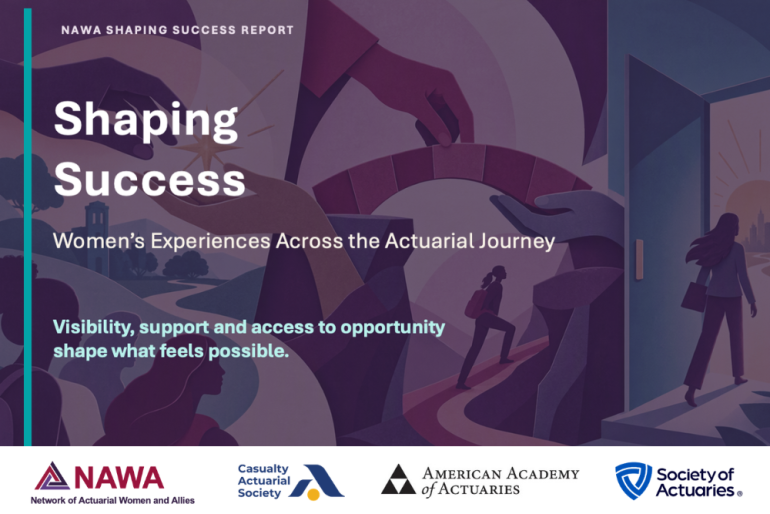
Research involving more than 3,500 respondents shows how visibility, support, and access to opportunity shape women’s experiences across the actuarial career journey
• • •
WASHINGTON, D.C. — October 28, 2026 — The Network of Actuarial Women and Allies (NAWA) released Shaping Success: Women’s Experiences Across the Actuarial Journey, a national study examining the experiences of more than 3,500 college students, actuarial candidates, credentialed actuaries, and STEM professionals.
Conducted by C+R Research, the study was sponsored by NAWA, as well as the American Academy of Actuaries, the Casualty Actuarial Society, and the Society of Actuaries. It examines three connected stages for women on their actuarial career path: discovering the profession, persisting through examinations, and advancing through a career.
“What this research reveals is how access to information, support, flexibility, sponsorship, and opportunity shapes women’s experiences across the actuarial career journey,” said Amber Rohde, FCAS, cofounder and Board member of NAWA. “The encouraging finding is that these are conditions the profession can change.”
Discover: Familiarity opens the door and impact matters
Among first- and second-year college students included in the analysis, 15% of women say they are familiar with the actuarial profession, compared with 24% of men. These students completed AP math in high school and are now taking advanced math classes or considering a STEM major or career, but have not yet taken actuarial exams. Once familiar, women and men are similarly likely to consider an actuarial career (60% and 61%, respectively). Familiarity is the gateway to consideration.
How the profession is presented also matters. 61% of college women surveyed say making a positive impact is very influential in their career choice, compared with 47% of men, yet only 21% of relevant college students and 19% of STEM professionals associate actuarial work with positive impact. The profession has an opportunity to show how actuarial work creates value for people and communities.
Schools are a proven channel to the profession. School advisors were rated very helpful for career exploration by 47% of women and 35% of men; mentors were rated very helpful by 40% of women and 32% of men. Among credentialed actuaries, school mentors and professionals were the leading source of initial awareness, cited by 45% of women and 50% of men. Yet only 34% of women of color reported awareness through this channel, pointing to an opportunity to expand a pathway that is already working for some.
Persist: Added burdens put persistence at risk
Women encounter barriers when the demands of the actuarial exam process compete with other responsibilities and priorities. At this stage, support from mentors and others, along with the resilience to recover from setbacks, is vital.
Among actuarial exam candidates no longer pursuing an actuarial career, insufficient study time was cited by 44% of women, compared to 16% of men. Respondents also described family timing and caregiving responsibilities, burnout and impostor syndrome, limited community, and too few women mentors as having a negative impact. Together, these burdens can turn an ordinary setback into a persistence risk.
Practical support can help candidates continue: employers prioritizing study time, normalizing retakes and nonlinear career pathways, building community and mentoring, and offering flexibility across life stages. “Maintaining the rigor of actuarial credentials and supporting candidates throughout the examination process are not mutually exclusive,” said Rohde. “We can preserve high professional standards while making the journey more achievable, supported, and less isolating.”
Advance: Visibility and advocacy expand opportunity
Among credentialed actuaries, 69% of women report encountering cultural challenges when pursuing high-level roles, compared with 55% of men. Women described greater pressure to prove themselves, subtle unwelcoming behaviors, exclusion from informal networks, and career penalties associated with motherhood and caregiving.
Women are also more than twice as likely as men to report observing or experiencing gender discrimination, 48% compared with 21%. The difference becomes more pronounced across the career journey. Reports among women rise from 29% at the pre-associateship stage to 61% at the highest career levels; the corresponding figures for men are 14% and 26%. The differences within each career stage hold even after controlling for years of experience.
The findings also highlight gaps in recognition, sponsorship, and access to opportunity affecting women. Flexible arrangements can help sustain career progression, but they are not always available, supported, or championed. Even when flexibility is available, reduced visibility with decision-makers and less access to important assignments can limit recognition and advancement opportunities.
Strong support systems can help counter these barriers. Organizations and managers help determine who receives high-value projects, exposure to leaders, and opportunities to grow. Mentors offer guidance, sponsors create opportunity, and advocates help ensure work is seen, credited, and connected to advancement.
The study identifies three opportunities for action
- Make the profession visible and highlight impact. Introduce actuarial careers earlier, relate actuarial work to positive impact, and equip educators, mentors, and actuaries to open doors to the career.
- Help candidates persist. Protect study time, normalize exam retakes and nonlinear career progression, build community, and reduce structural friction so setbacks remain recoverable.
- Expand access to opportunity. Make flexibility usable without sacrificing recognition, leadership exposure, or access to valuable work, and strengthen sponsorship, advocacy, and mentoring to create clearer pathways to leadership.
“No single organization can address every point in this journey,” said Rohde. “Educators, employers, credentialing organizations, managers, mentors, sponsors, advocates, allies, and actuaries all have a role. We can tell the impact story, make setbacks recoverable, and use influence to connect women to opportunities for growth and leadership.”
Visit NawaActuaries.org to learn more about the study, access related resources, and explore partnership opportunities.
About NAWA
The Network of Actuarial Women and Allies (NAWA) is an international community where women actuaries and their allies can thrive at every stage of their careers. NAWA’s mission is to connect and empower women and allies of all backgrounds, races, ethnicities, and life circumstances to be successful in the actuarial profession. Through mentorship, education, community, and advocacy, NAWA helps members grow, lead, and belong while working with allies and organizations to shape a more inclusive profession. Learn more at NawaActuaries.org.
About the American Academy of Actuaries
With a mission to serve the public and the U.S. actuarial profession, the American Academy of Actuaries is the national association representing all actuaries practicing in the U.S. For more than 60 years, the Academy has assisted public policymakers on all levels by providing leadership, objective expertise, and actuarial advice on risk and financial security issues. The Academy also sets qualification, practice, and professionalism standards for actuaries in the United States. Learn more at actuary.org.
About the Casualty Actuarial Society
For over 100 years, the Casualty Actuarial Society (CAS) has been the trusted global authority advancing the practice of property and casualty actuarial science, with nearly 12,000 members worldwide who apply their expertise to help people, businesses, and communities unlock opportunities and thrive in a rapidly changing world. The CAS delivers credentialing, research, learning, and professional development grounded in real-world application. Learn more at casact.org.
About the Society of Actuaries
With roots dating back to 1889, the Society of Actuaries (SOA) is the world’s largest actuarial professional organization with more than 35,000 actuaries as members in more than 100 countries. SOA’s purpose is to empower its members to drive solutions to life’s financial risks. To learn more, visit soa.org.
Media Contact
Aree Bly, Board Member
Network of Actuarial Women and Allies
Aree@NawaActuaries.org
+1 (303) 475-6151
